--------------------------------------------------------------------------------------------------------------------------------------------------------------------------------------------------------------------------------------------------------------------------------------------------------------------------------------------------------------------------------------------------------------- |
Defending Christianity – Christian Apologetics
|
Christianity invites both faith and thoughtful enquiry, encouraging us to love God with our minds as well as our hearts. These free Christian illustrations explore biblical apologetics, offering clear and memorable ways to understand the evidence for God, the reliability of the Bible and the truth of the gospel message.
|
---------------------------------------------------------------------------------------------------------------- |
When God Knocks
 A teenage boy was engrossed in a computer game when he heard a knock at the front door. He chose to ignore it. A teenage boy was engrossed in a computer game when he heard a knock at the front door. He chose to ignore it.
A few moments later, his mother came downstairs and asked, “Did you answer the door?”
Without taking his eyes off the screen, the boy replied, “I didn’t want to. Someone might have been there, and I’d have to stop my game!”
Many people respond to God in much the same way. We deny His existence for all sorts of reasons. Sometimes it is because we simply don’t want Him to exist. We become so absorbed in pursuing possessions, pleasure or personal ambition that we fear acknowledging God might interrupt our plans. Others have accepted naturalistic explanations for life for so long that they regard them as unquestionable fact and are unwilling to consider the evidence for a Creator.
Yet God continually reveals Himself. His handiwork is displayed throughout Creation, His truth is declared in His Word, our conscience testifies to right and wrong, and He often speaks through Christian evangelists, family members and friends who lovingly encourage us to consider His claims. The evidence is there, but many choose not to answer because they suspect that if God is real, their lives may have to change.
God will never force His way into our lives, but patiently knocks and invites us to respond. The One standing at the door is the Creator of the universe, offering forgiveness, new life and eternal salvation. Any change He brings into our lives will only be a change for the better. How tragic it would be to ignore the greatest invitation ever given simply because we were too preoccupied with the passing things of this world. Some interruptions are worth answering.
“Behold, I stand at the door and knock. If anyone hears My voice and opens the door, I will come in to him and dine with him, and he with me.” Revelations 3:20.
Back to Top ----------------------------------------------------------------------------------------------- |
The Amazing Constructive Explosion
 An explosion is a sudden, violent release of energy that causes destruction. Whether it’s a bomb, a gas leak, or a volcanic eruption, the aftermath is always disorder, not order. Things break apart, structures are shattered, and chaos follows. Explosions don’t build – they destroy. An explosion is a sudden, violent release of energy that causes destruction. Whether it’s a bomb, a gas leak, or a volcanic eruption, the aftermath is always disorder, not order. Things break apart, structures are shattered, and chaos follows. Explosions don’t build – they destroy.
Today, many accept the theory that the universe began with an explosion – the so-called “Big Bang” – which somehow created everything we see. It’s a strange contradiction. We all know explosions destroy things, not design them. Still, the Big Bang is often taught as a magical, constructive explosion that built galaxies, stars, life, and laws of physics – from nothing, with no cause, no plan, and no guiding hand. That’s not science – that’s faith in chaos.
But is that even reasonable? Consider these five simple facts:
1. Explosions cause disorder, not intricate design. Order doesn’t arise from chaos
without guidance.
2. Laws of physics require a Lawgiver. Physical laws don’t pop into being – they
must be set.
3. Life comes from life, not lifeless matter. No random blast has ever birthed life.
4. Information (like DNA) always comes from intelligence. You never get a book
from a bang.
5. Nothing comes from nothing. If there was truly nothing before, then nothing could
exist now.
We’ve all seen what explosions do. Not once have they built something complex or beautiful – they only destroy. Why then, do some build their worldview on the belief that everything began with an uncaused explosion from nothing? That’s not evidence – it’s imagination dressed up as science. Let’s not construct our beliefs on baseless theories that contradict the reality we observe daily.
The Bible offers a far better explanation: an eternal, intelligent Creator who brought the universe into existence with purpose and design. He is unseen, but not unknowable. He promises to reveal Himself to those who truly seek Him.
The heavens declare the glory of God; and the firmament shows His handiwork. Psalm 19:1.
Back to Top ------------------------------------------------------------------------------------------------ |
Where is the Evidence?
 If someone claimed elephants evolved from prehistoric flying pigs, you’d probably raise an eyebrow and ask to see the evidence before buying into it. And if they admitted the evidence was missing? Well, it’d take a fair bit of faith to believe them. If someone claimed elephants evolved from prehistoric flying pigs, you’d probably raise an eyebrow and ask to see the evidence before buying into it. And if they admitted the evidence was missing? Well, it’d take a fair bit of faith to believe them.
We are often told evolution explains our origins. In simple terms, it teaches that in the beginning there was nothing, which exploded, and gradually created everything.
It would seem that one of the world’s greatest acts of faith is placed in evolution and its ever-changing theories. Yet, largely unbeknown to the general public, the fossil record – despite containing more than 250,000 identified species – does not provide clear, universally agreed-upon examples of one kind of organism transitioning into another. Proposed links between humans and apes remain heavily debated by experts as unfit candidates.
Furthermore, no one has ever observed lifeless chemicals arranging themselves into the complex, information-rich biomolecules required for life. The probability of even a single protein molecule forming by chance is so astronomically small that it stretches the limits of mathematical plausibility. Yet even the simplest theoretical life form would require hundreds of such proteins working together in precise order. Many scholars conclude it’s simply impossible. Alternatively, stoic atheists respond it’s not impossible, just highly improbable; then state, it must have happened because life now exits – we just don’t know how it happened – yet.
It takes faith to believe in God – it takes faith to believe in theories of evolution. It is somewhat ironic that many reject Christianity on the basis of a perceived lack of evidence, while accepting evolutionary theories without asking the same question: where is the evidence?
Some claim belief in God is unscientific. Yet, today many well-known and respected scientists have concluded that the complexity and order of the universe point to an intelligent Creator. Like these scientists, we should take a closer look at the evidence and consider where it truly points and give serious thought to whether it supports the claims of Christianity.
For since the creation of the world God’s invisible qualities – His eternal power and divine nature – have been clearly seen, being understood from what has been made, so that people are without excuse. Romans 1:20 NIV
Back to Top ------------------------------------------------------------------------------------------------ |
The Big Bang
 Some people refuse to believe in God and instead place their faith in scientific theories. They argue that rational people should reject the Bible's fanciful account of creation and accept explanations such as evolution and the Big Bang. Yet neither theory escapes the fundamental question of origins: Where did everything come from? Some people refuse to believe in God and instead place their faith in scientific theories. They argue that rational people should reject the Bible's fanciful account of creation and accept explanations such as evolution and the Big Bang. Yet neither theory escapes the fundamental question of origins: Where did everything come from?
Evolution seeks to explain how life developed from simpler forms over millions of years. Whether one accepts or rejects that explanation, it does not answer how the first living cell came into existence. When confronted with this question, some suggest that life originated elsewhere in the universe. But this merely shifts the problem to another location. Where did that life come from? Continue tracing the chain backwards and the same question remains: Where did the very first life originate?
The same dilemma applies to the universe itself. Either the universe has always existed, or it had a beginning. If it had a beginning, what caused it? The Big Bang theory describes the early expansion of the universe from an extremely hot, dense state, but it does not explain why matter, energy, space and time existed in the first place. Why is there something rather than nothing? Something cannot create itself, and nothing has no power to create anything.
The Bible begins with a simple yet profound declaration: "In the beginning God created the heavens and the earth." (Genesis 1:1). Rather than claiming the universe created itself, Christianity points to an eternal Creator who exists beyond space, time and matter, and is therefore not bound by them.
Every worldview must ultimately answer the question of first cause. Was the universe eternal? Did everything somehow arise without a sufficient cause? Or is there an eternal Creator behind it all? None of us witnessed the beginning, so every position involves faith. The question is not whether we have faith, but where we place it.
The remarkable order, complexity and fine-tuning of the universe are consistent with the work of an intelligent Designer. The heavens not only inspire wonder, they point us to the One who made them.
The heavens declare the glory of God; and the firmament shows His handiwork. (Psalm 19:1)
Back to Top ------------------------------------------------------------------------------------------------ |
Nature's Program
 Computers operate via a series of coded instructions called programs. Few of us meet the programmers who coded these programs; however, we don’t delude ourselves into thinking computers initially programmed themselves. Computers operate via a series of coded instructions called programs. Few of us meet the programmers who coded these programs; however, we don’t delude ourselves into thinking computers initially programmed themselves.
How do birds know how to build a nest? How do bees know how to make honey? How do beavers know how to dam a river? How do spiders know how to design a web? How can certain fish and birds migrate thousands of kilometres then return each year with satellite accuracy? How do miniscule, blind, newly born kangaroos know to wriggle their way from the birth canal all the way to the mother’s pouch to suckle milk? There are so many inexplicable natural phenomena swept under the carpet with the word, ‘INSTINCT’. Do we delude ourselves thinking everything in nature has programmed itself?
In fields such as engineering, academic minds continue to learn complex lessons from the natural world. Shouldn’t we be asking where nature learnt these lessons, or will we casually say: ‘Given enough time they happen and program themselves?’
The Bible declares that in nature, everything is created by God. Therefore, He is the Original Programmer who wrote the coded instructions we call, ‘instinct’. The Bible also declares that there is ample evidence of God’s existence through nature for those who honestly seek Him.
It may be inconvenient for us to acknowledge that there is a God. It’s much easier for us to blindly accept the theories of: ‘In the beginning was nothing – the nothing exploded then gradually created and programmed all the complexities in nature.’ But keep in mind, God is not threatened by our disbelief in Him; however, the Bible states He will hold us accountable of our rejection of Him and we are without excuse. Furthermore, we are also accountable for rejecting His precious gift of salvation accomplished through the death of His son, Jesus Christ, on the cross, (John 3:36).
Let us seek God while we still have time; God promises all who seek Him will find Him, (Mat. 7:7-8) and this is the first step to receiving everlasting life through Christ.
For since the creation of the world His invisible attributes are clearly seen, being understood by the things that are made, even His eternal power and Godhead, so that they are without excuse. Romans 1:20
Back to Top ------------------------------------------------------------------------------------------------ |
The Intelligent Designer
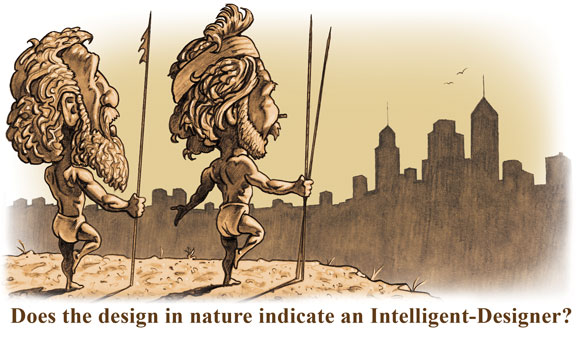 Two bushmen, who lived in the remote outback, went for a long walk and stumbled upon a city. Two bushmen, who lived in the remote outback, went for a long walk and stumbled upon a city.
‘Wow! How do you think that got there?’ one asked the other.
The second bushman, who considered himself quite scientific, replied: ‘Well, there are two theories. First, there is the “Big-Prang Theory” where two mountains collided and all the rocks accidentally fell into place, forming what you see before you. The second theory which most educated people accept is known as the “Ever-Popular-Solution” or “Evolution” for short. This is where, given the right circumstances and enough time, rocks and minerals arrange themselves into complex mathematical shapes, complete with flashing lights and strange vehicles whizzing around them.’
The first bushman scratched his head, saying: ‘I don’t know, mate - it seems as if someone designed it.’
‘Don’t be stupid,’ laughed the second. ‘You’ve gotta be pretty simple-minded to believe that.’
It is just as unlikely for a city to accidentally form itself as a DNA molecule (the most efficient information storage system in the known universe) is to form accidentally. Or, to use another example, frayed dinosaur scales transforming into symmetrical bird feathers is as likely as a frayed t-shirt transforming into an Armani suit.
Many eminent scientists, who see the enormous problems in outdated and unproven theories, are re-examining the scientific facts and concluding that everything in creation has intelligent design. So if there is intelligent design to creation, wouldn’t that indicate there is an Intelligent Designer?
For since the creation of the world His invisible attributes are clearly seen, being understood by the things that are made, even His eternal power and Godhead, so that they are without excuse. Romans 1:20.
Back to Top ------------------------------------------------------------------------------------------------ |
The Voice of God
 There are so many sounds around us every single day: birds chattering at sunrise, the hum of traffic, the rustle of leaves in the breeze. At first we notice them, but before long they become part of the background, fading into the familiar soundtrack of life. The same thing can happen spiritually. There are so many sounds around us every single day: birds chattering at sunrise, the hum of traffic, the rustle of leaves in the breeze. At first we notice them, but before long they become part of the background, fading into the familiar soundtrack of life. The same thing can happen spiritually.
Many people say, ‘If God exists, why doesn’t He reveal Himself with a big, booming voice from Heaven?’
God may be speaking, nudging, whispering, but when His voice becomes familiar – or when life gets too noisy – we can stop paying attention without even realising it.
God purposely created us with free will. He’s a Gentleman – never pushy, never forcing Himself upon anyone. While His voice can shake mountains (1 Kings 19:11–13), a thunderous declaration from the sky would frighten us into blind submission rather than genuine love.
God doesn’t want us to follow Him out of fear, but out of a willing heart. That’s not to say He’s silent. Far from it. He often speaks in a gentle, whisper-soft voice – a voice that respects our freedom to choose. Many of us call that still, small voice our conscience. It’s His way of guiding, prompting, correcting, and comforting. Yet all too often we tell Him to hush… or we’ve tuned Him out without noticing.
God speaks to us in countless ways: through the beauty and order of Creation, through the quiet tug of our conscience, through the godly words and actions of others, and through the pages of the Bible. None of these are invasive. Each one invites us – never compels us – to lean in and listen.
And here’s the good news: it’s never too late to tune back in. If we take time to pause and listen, we may find that God’s gentle whisper has been there all along, waiting to bring comfort, direction, and hope.
“Be still, and know that I am God.” Psalm 46:10
Back to Top ------------------------------------------------------------------------------------------------ |
Tracking Evolution
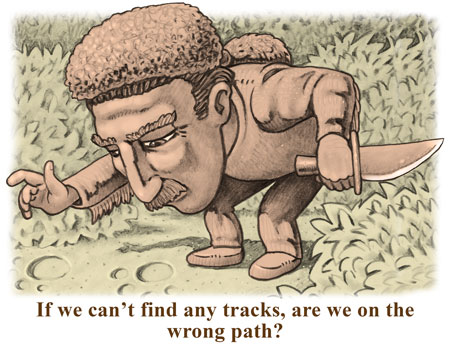 A good tracker soon finds where someone or something has been by following various signs of progression. If no evidence is found, the tracker quickly concludes he is on the wrong track. A good tracker soon finds where someone or something has been by following various signs of progression. If no evidence is found, the tracker quickly concludes he is on the wrong track.
Charles Darwin (father of the theory of evolution) argued that accumulated small changes eventually lead to new species. If this were so we would be able to track these changes to their origin. However, no fossils have been found to link one species with another – the missing links still remain missing.
Darwin also stated (in Origin of Species, 6th edition, New York University Press, 1988. P. 154), that if it could be demonstrated that any complex organ existed which ‘could not’ possibly have been formed by numerous, successive, slight modifications, his theory would break down.
As science has developed, we learn that many organs are too complex to be reduced by numerous, successive, slight modifications. Dr Michael J Behe, professor of biochemistry at Lehigh University concludes ‘no one … can give a detailed account of how the cilium, or vision, or blood clotting, or any complex biochemical process might have developed in a Darwinian fashion.’(Behe p. 187).
However, supporters of evolution claim that it’s not impossible but merely improbable that organs, such as the eyeball, have evolved. The honest evolutionist will admit their theories are extremely improbable, but conversely they believe the existence of God is more improbable than evolution, so they conclude one belief is fact while the other is fiction based on their gamble of improbabilities.
So what should we think? Since science has come to so many dead ends tracking evolution, maybe it’s time to admit it’s on the wrong track. We should take Darwin’s own advice and bin his theories, then start considering the complex design behind nature and the One who designed it.
“You are worthy, O Lord, to receive glory and honour and power; for You created all things, and by Your will they exist and were created.” Revelations 4:11
Back to Top ------------------------------------------------------------------------------------------------ |
The Artist behind the Artworks
 A wealthy artist decided to create something special for the city he loved. For years he quietly crafted one masterpiece after another. When the collection was complete, he built a magnificent gallery, filled it with his artwork and opened the doors free to the public. Then he sat back to watch people’s reactions. A wealthy artist decided to create something special for the city he loved. For years he quietly crafted one masterpiece after another. When the collection was complete, he built a magnificent gallery, filled it with his artwork and opened the doors free to the public. Then he sat back to watch people’s reactions.
Crowds soon poured through the gallery. They marvelled at the paintings, admired the sculptures and praised the beauty and skill on display. Yet the artist was deeply disappointed. Not one person wondered who had created the masterpieces or thanked the one who made them. Instead, they convinced themselves that the gallery had somehow appeared by itself and the artworks had formed through a series of fortunate accidents.
As strange as that sounds, many people approach the natural world in much the same way. Scientists rightly uncover astonishing design, order and finely tuned laws throughout the universe. They marvel at the incredible information encoded within living cells and the breathtaking complexity of life. Yet many stop short of asking the obvious question: Who is the Artist behind the artwork?
Science is wonderfully equipped to explore how the universe works, but it cannot explain why anything exists in the first place, why the laws of nature are so precise, or where the information necessary for life originally came from. Those questions point beyond creation to a Creator.
The universe is not simply a masterpiece to be admired – it is a signpost directing us to the One who made it. Every sunrise, every star and every living creature quietly bears witness to the greatest Artist of all.
The heavens declare the glory of God; and the firmament shows His handiwork. Psalm 19:1.
Back to Top ------------------------------------------------------------------------------------------------ |
Blind or Evidence-based Faith
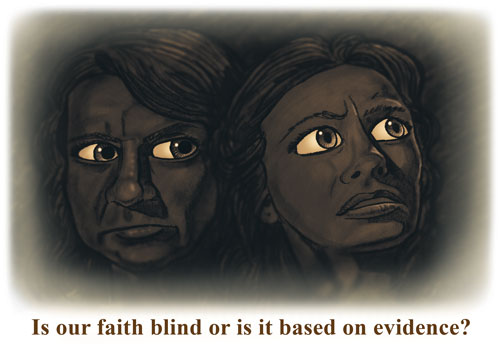 Two women were lost underground in total darkness. After hours of waiting, one said, ‘I believe we should go this way.’ Two women were lost underground in total darkness. After hours of waiting, one said, ‘I believe we should go this way.’
The other replied, ‘Why should I follow you? We’re both lost.”
‘I’m not certain,’ said the first, ‘but the tunnel slopes upward, there’s a breeze, and it’s slightly brighter – signs there may be a way out.’
In life, we are all navigating in darkness, asking big questions like: Is there a God? Is there meaning to life? Is there life after death? Whether we believe: ‘yes’ or ‘no’, it requires faith.
No one can fully prove the origin of the universe or life. Evolution, while widely taught, remains a theory with gaps. Atheists rely on unproven theories, such as the Big Bang, which suggests that an explosion from ‘nothing’ produced an ordered, complex universe. Yet, some atheists ironically mock Christians for having ‘blind faith,’ claiming no science supports their worldview – God is a delusionary fairy-tale.
However, many Christians base their beliefs on evidence. They see order and consistency in scientific laws and reason there must be a Lawgiver. They marvel at the complex design in nature (such as DNA), and ponder the mystery of self-awareness (something science cannot fully explain or replicate) and conclude there is a Divine Creator. While Christians’ belief in a God cannot be proven, their faith is not blind or delusionary. It is evidence-based, grounded in reason and scientific observation.
God has not left humanity to stumble around in darkness – strong evidence points to Him. Maybe it’s time we took a step-of-faith and start heading in His direction.
Romans 1:20 states: For since the creation of the world God’s invisible qualities – His eternal power and divine nature – have been clearly seen, being understood from what has been made, so that people are without excuse.
Back to Top ------------------------------------------------------------------------------------------------ |
The Infinite God.
 Each night, the universe stares down and challenges us to understand it. The further we explore it, the more we discover how little we really know. Does the universe have an edge? If it does, what is beyond it? If it has no edge, how can something be without end? Our finite minds can describe infinity, yet they cannot truly comprehend something with no beginning, no end and no limits. Each night, the universe stares down and challenges us to understand it. The further we explore it, the more we discover how little we really know. Does the universe have an edge? If it does, what is beyond it? If it has no edge, how can something be without end? Our finite minds can describe infinity, yet they cannot truly comprehend something with no beginning, no end and no limits.
This is the dilemma. We readily accept that there are realities beyond our complete understanding, yet many are reluctant to believe in anything that cannot be measured or fully explained. The universe itself continually reminds us that human knowledge has its limits.
Similarly, an infinite God is far beyond the grasp of finite minds. The Bible describes God as eternal – without beginning or end. He is all-powerful, all-knowing and present everywhere at once. We cannot measure Him, nor can we fully comprehend Him (Isaiah 40:12–14).
Yet many dismiss God with the question, "If God exists, who created Him?" The question assumes that everything must have a beginning. But the Bible declares that God has always existed. He is not part of creation; He is the Creator of it (Psalm 90:2). An eternal Being, by definition, has no beginning and therefore no creator.
Many confidently declare, "There is no God," simply because they cannot reduce an infinite, eternal Being to human understanding. But should we expect the Creator of the universe to fit neatly within the limits of the human mind? If we struggle to comprehend the vastness of creation, why should we expect to fully comprehend the One who created it?
Perhaps our inability to fully understand God is not evidence that He does not exist, but evidence that we are finite and He is infinite.
“God who made the world and everything in it, since He is Lord of heaven and earth, does not dwell in temples made with hands. Nor is He worshiped with men’s hands, as though He needed anything, since He gives to all life, breath, and all things.” Acts 17:24-25
Back to Top ------------------------------------------------------------------------------------------------ |
A Creator behind Creation.
 A book needs an author. A program needs a programmer. A poem needs a poet. A design needs a designer. An invention needs an inventor. So it’s only natural to ask – doesn’t creation point to a Creator? A book needs an author. A program needs a programmer. A poem needs a poet. A design needs a designer. An invention needs an inventor. So it’s only natural to ask – doesn’t creation point to a Creator?
When you look at a painting, you don’t assume it painted itself. It’s obvious there’s an artist behind it. In the same way, when we look at the natural world, we see order, purpose, and astonishing complexity.
Take animals, for example. They’re wired for survival – what zoologists call instinct. But where did that “programming” come from? Or consider the laws of science: they’re consistent, measurable, and dependable. But laws don’t enforce themselves – they require a lawgiver. If the universe operates according to precise, orderly rules, it’s reasonable to ask who established and sustains them.
We also observe design throughout creation. From the vastness of space to the intricacy of DNA – the most efficient information storage system we know – everything bears the marks of intentional design. It stretches belief to say that such complexity organised itself without guidance.
Some point to evolution as the answer – suggesting that, given enough time, everything formed itself, ultimately from nothing. But even if we allow for evolutionary processes, they still don’t explain the origin of life, the source of information, or why the universe is so finely tuned for existence in the first place.
In the end, we’re faced with a choice: either everything came from nothing, for no reason, or there is a powerful, intelligent Creator behind it all.
Interestingly, as science continues to uncover the fine-tuning and complexity of the universe, many well-respected scientists and academics are beginning to question long-held assumptions about our origins. More and more, their conclusions echo the words of Psalm 19:1: The heavens declare the glory of God; and the firmament shows His Handiwork.
Back to Top ------------------------------------------------------------------------------------------------
|
Swimming Aimlessly
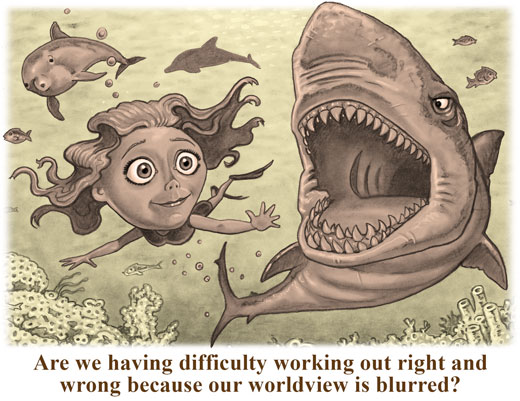 When we dive into the ocean with our eyes open but without a diving mask, our vision is blurred and we can’t clearly identify the objects surrounding us. However, when we put on our goggles, the sea world suddenly comes into focus. We can now appreciate the ocean’s beauty in a way we couldn’t before and can quickly identify what is friendly and what is not. When we dive into the ocean with our eyes open but without a diving mask, our vision is blurred and we can’t clearly identify the objects surrounding us. However, when we put on our goggles, the sea world suddenly comes into focus. We can now appreciate the ocean’s beauty in a way we couldn’t before and can quickly identify what is friendly and what is not.
Life can seem pretty vague. For many of us, we journey aimlessly through our lives trying to find sense and purpose to something that seems pointless. When we accept theories of evolution and atheism, our worldview becomes a Godless universe. We have accepted that our existence is a random accident and if there is a purpose to our life, it’s simply to breed and then expire. Everything becomes relative – right and wrong becomes blurred and we lose the ability to properly identify what is good or bad.
Today, many people are in a funk. Depression is an ever-present shadow. Life is endured not embraced. People have lost their focus and their way, but sadly few will change because they are wise in their own understanding.
Yet, if we look at life through the Word of God (the Bible), everything takes on a completely different appearance. We will see things with a clarity that could never be attained relying on our own sight. Suddenly, there is understanding as to why certain things happen. We can discern beauty in a way we could never appreciate before. We can identify right from wrong thus avoiding many snares. We can also see a purpose and meaning to our existence.
God never intended us to travel through life disorientated and vulnerable to every danger. He gave us His Word to see clearly. The choice is up to us: we can either go through life relying on our own understanding or put on God-goggles and observe things through His eyes. When we start seeing our circumstances and other people from God’s perspective, we quickly develop patience and grace; things cease to bother us; we are more relaxed and life becomes so much better.
Trust in the Lord with all your heart, and lean not on your own understanding; in all your ways acknowledge Him, and He shall direct your paths.Proverbs 3: 5-6.
Back to Top ------------------------------------------------------------------------------------------------ |
Absolute Truth
 A psychologist said to his patient: ‘Most crazy people think they are sane.’ A psychologist said to his patient: ‘Most crazy people think they are sane.’
The woman replied: ‘But I think I’m sane.’
‘Ah-ha,’ said the psychologist, ‘that only proves you’re crazy.’
The world regards people who believe in God as crazy. As Christians, what can we say to those who assume their evolutionary world-view is proven fact? Sadly, very little – any view which differs to theirs is simply seen as foolish ignorance, (1 Corinthians 2:14).
Investigative science can neither prove nor disprove God’s existence; still, many prominent scientists declare God is fiction purely on the basis of improbability. Ironically, they quickly show their bias double-standard by stating that the impossible problems in their ‘theories of evolution’ should not be labelled impossible, but merely improbable.
The fact is: all origin theories are based on unproven foundations and personal belief. In the end, no matter what people say, hypothesize or believe, there can be only one immutable and absolute truth which will not bend for any clever ‘theories’ in the realms of science, psychology or religion.
The issue facing all creatures with free-will is: ‘What will we choose to believe?’ Most people will run with the herd, not questioning the popular view in case they are labelled ignorant, bigoted or crazy. However, if life teaches us anything, we are all accountable for our beliefs and the choices we make or don’t make – no matter what people think of us.
He who believes in the Son (Jesus Christ) has everlasting life; and he who does not believe the Son shall not see life, but the wrath of God abides on him. John 3:36.
Back to Top ------------------------------------------------------------------------------------------------ |
IQ Test
 We label a person as either an imbecile or a genius based on the results of an IQ test – which in turn depend simply on the number of questions answered correctly in a given time. We label a person as either an imbecile or a genius based on the results of an IQ test – which in turn depend simply on the number of questions answered correctly in a given time.
There is another IQ test which eternally classifies us as genius or imbecile. God has given us a certain amount of time (life on earth) to answer one simple question - what do you think of Christ? Our answer will determine whether we are an eternal genius or an eternal imbecile.
Isn’t it amazing that the IQ test that really matters has only one question – Do you believe Jesus Christ paid the penalty for your wrongdoings and died on your behalf so you may have everlasting life? One correct answer can make a foolish believer wiser than the most brilliant unbeliever.
Let no one deceive himself. If anyone among you seems to be wise in this age, let him become a fool that he may become wise. For the wisdom of this world is foolishness with God. For it is written, “He catches the wise in their own craftiness”, 1 Corinthians 3: 18-19.
Back to Top ------------------------------------------------------------------------------------------------ |
Consistent Laws.
 Sir Isaac Newton recognised that the laws of the physical world are constant when he stated: ‘For every action there is an equal and opposite reaction.’ This is a law worth remembering before stepping from a great height. Sir Isaac Newton recognised that the laws of the physical world are constant when he stated: ‘For every action there is an equal and opposite reaction.’ This is a law worth remembering before stepping from a great height.
God established the laws that govern the universe and decreed that they remain constant. I have spoken it, I will also bring it to pass; I have purposed it, I will also do it. Isaiah 46:11b.
God also created mankind with volition and decreed that it would remain free. The laws of freewill are as constant as any scientific law in the physical world. Every decision has consequences. We are free to make our own choices, but we are ‘not’ free to choose their outcome. Much of the suffering in our world is the result of humanity’s decisions – our own, those of others, and the collective choices of nations.
We may point our finger accusingly at God and ask: ‘How can You allow suffering?’ But God rarely intervenes when it comes to the repercussions caused by our own foolish decisions. We may earnestly pray for Him to miraculously remove the bad repercussions (though we never ask Him to remove the good ones), but God would sooner suspend the law of gravity than tamper with the law of free will.
While we cannot always choose our circumstances, we can choose how we respond to them. Our attitude often determines whether we have dug ourselves ‘out’ of a hole or dug ourselves ‘into’ a grave. This is not to say God leaves us alone to deal with life’s problems. He has promised to bring us through adversity, not simply out of it, working even the most difficult circumstances for good (Romans 8:28).
Our choices are like seeds. In time, every seed produces a harvest – and none of us want bad apples. Thankfully, God gives us the wisdom to sow well, the strength to keep going and the grace to begin again when we have sown poorly.
“Do not be deceived, God is not mocked; for whatever a man sows, that he will also reap...” Galatians 6:7–8.
Back to Top ------------------------------------------------------------------------------------------------
|
Defined by a Meaning
 A word only has meaning when defined. Without definition a word is simply an empty sound. A word only has meaning when defined. Without definition a word is simply an empty sound.
Likewise, our life only has meaning when it is defined. We define ourselves by what we believe. If we believe in unproven ‘theories’ of evolution, we believe our life is merely the result of many miraculous mishaps. We define ourselves and our children as cosmic accidents with no high purpose – born simply to reproduce and then to die. If we believe in ‘nothing’, sadly we are defined by our belief, (ironically, evolutionists find meaning in trying to prove that life is meaningless).
As a word without definition is a meaningless sound, so, too, a life defined by ‘nothing’ is sadly a meaningless existence.
On the flip side, as God has stated in the Bible, we are not ‘nothings’. We are actually so important that the Creator of the universe took on the form of a man (Jesus Christ) and paid the complete penalty for all transgressions (sins) that any who believe on Him (Christ) will have everlasting life. God defines us as His sons and daughters, much beloved by Him (2 Corinthians 5:17).
Furthermore, God has given us a higher purpose in life with which to define ourselves. When we identify with His purpose, our life is filled with meaning and we become motivated to run the race that God has set before us.
Jesus said to her, “I am the resurrection and the life. He who believes in Me, though he may die, he shall live. And whoever lives and believes in Me shall never die. Do you believe this?” John 11:25-26.
Back to Top ------------------------------------------------------------------------------------------------ |
Toppling Idols
 In the Old Testament, before the Judges of Israel could bring their people back to God they had to knock down the idols that were being worshiped. In the Old Testament, before the Judges of Israel could bring their people back to God they had to knock down the idols that were being worshiped.
Before our friends and neighbours give the Gospel a hearing, we sometimes need to knock down the idols they are worshipping. Today, the idol is evolutionary thinking. Sadly, most people don’t believe evolution is a theory but an established fact.
It is handy for Christians to have an understanding of “evolution versus creation” to give rational answers when people question. There are plenty of examples in nature and science that illuminate the design in creation and points to the Designer behind it, (Google the many eminent Christian professors and doctors that have written excellent scientific defences for God and Christianity).
However, there is an occupational hazard to Christian apologetics. We can become so caught up arguing evolution that we neglect to mention the Gospel. Many educated Christians have won academic debates, but without the Gospel no one has been won to Christ. We must remember that: The Word of God is alive and powerful… (Hebrews 4:12). God honours His Word, not our clever arguments. When His Gospel is spoken, God will rattle the hearer to its importance and will haunt them with its message time and time again.
There is a certainly place for Christian apologetics in toppling evolutionary idols, but without the Gospel it’s simply an academic argument. Blessed be the God and Father of our Lord Jesus Christ, who according to His abundant mercy has begotten us again to a living hope through the resurrection of Jesus Christ from the dead. (1 Peter 1:3)
Back to Top ------------------------------------------------------------------------------------------------ |
Religion Versus Christianity
 If a doctor misdiagnoses you or treats you terribly, it can shake your trust. But it wouldn’t be wise to reject medicine altogether because of one bad experience. The failure lies with the practitioner, not the practice itself. If a doctor misdiagnoses you or treats you terribly, it can shake your trust. But it wouldn’t be wise to reject medicine altogether because of one bad experience. The failure lies with the practitioner, not the practice itself.
In much the same way, many people reject Christianity because of the terrible things done in the name of religion. Yet we often overlook an important point: Jesus Christ Himself was not impressed with religion either. In fact, it was religious people who conspired to have Him crucified.
The Bible teaches that Jesus is the Son of God – God revealed in human form (John 10:30). If that’s true, then His life shows us exactly what God is like. And what we see in Christ stands in sharp contrast to many of the actions carried out in religion’s name – violence, oppression, and abuse.
When Jesus walked the earth, He spoke strongly against hypocritical religious leaders. He drove out those exploiting others in the temple. He stood with courage and compassion between a woman and those ready to stone her. Again and again, He opposed the misuse of religion and defended the vulnerable.
Sadly, religion has often given Christianity a reputation it doesn’t deserve. But to judge Christianity solely on the failures of religious people is to judge it unfairly. Those actions don’t reflect Christ – they contradict Him.
Religion may wrong you, condemn you, malign you, or even go so far as to crucify you – but God’s desire is very different. He doesn’t burden people with empty rituals or leave them weighed down by guilt. Instead, He offers a relationship – one marked by forgiveness, grace, and restoration.
Christianity is not about trying harder to be good or following a set of rules. It is about being restored to a right relationship with our Heavenly Father through the saving work of Jesus Christ on the cross. This is a gift – freely given, not earned. The question is whether we will accept it.
As John 3:16 says: “For God so loved the world that He gave His only begotten Son (Jesus Christ), that whoever believes in Him should not perish but have everlasting life.”
Back to Top ------------------------------------------------------------------------------------------------ |
Our Moral Compass
 Deep beneath the earth’s surface, molten metals generate a magnetic field that surrounds our planet. Though invisible, this field is real and measurable. A compass works because its needle responds to that unseen force, consistently pointing north. We trust it because we can clearly observe its effects. Deep beneath the earth’s surface, molten metals generate a magnetic field that surrounds our planet. Though invisible, this field is real and measurable. A compass works because its needle responds to that unseen force, consistently pointing north. We trust it because we can clearly observe its effects.
In much the same way, God is invisible, yet His presence is evident through the world around us. We cannot see gravity, radio waves, or the wind, but we confidently believe they exist because we observe their effects. Likewise, the order of creation, the beauty of nature, human consciousness, and our inner awareness of morality all point beyond the material world to something greater.
A clear sign of God’s existence is humanity’s moral compass – the deep sense that some things are objectively right and wrong. Most people instinctively know that love, honesty, and justice are good, while cruelty, abuse, and murder are wrong. These are not merely personal opinions or cultural preferences; they are moral truths recognised across societies and throughout history.
This raises an important question: where do objective moral values come from? If moral truths exist independently of human opinion, then they require a source greater than humanity itself. Christianity teaches that this source is God – the perfectly good and righteous Creator who made us in His image. Because of this, human life has real value, justice truly matters, and love is more than a chemical reaction.
Without God, morality becomes difficult to justify objectively. If humans are merely cosmic accidents produced by blind chance, then morality becomes subjective. In that view, there is no ultimate basis for calling anything truly right or wrong, good or evil – only what individuals happen to prefer.
Yet our conscience continually points us higher. Like a compass needle drawn towards true north, the human heart longs for truth, goodness, and meaning. Our moral awareness is not an accident; it is evidence that we were created by a God who desires us to know Him and walk in His ways.
“He has shown you, O man, what is good; and what does the Lord require of you but to do justly, to love mercy, and to walk humbly with your God?” Micah 6:8.
Back to Top ------------------------------------------------------------------------------------------------ |
Divine Programmer.
 Computer programmers create programs that contain entire cyber worlds. Within these worlds are computer-generated characters that are limited by the boundaries of the program. However, it would be ludicrous to suggest the programmer is subject to those same boundaries. She exists outside the program and can change its rules whenever she chooses. Computer programmers create programs that contain entire cyber worlds. Within these worlds are computer-generated characters that are limited by the boundaries of the program. However, it would be ludicrous to suggest the programmer is subject to those same boundaries. She exists outside the program and can change its rules whenever she chooses.
In a similar way, God created the universe and everything in it (Nehemiah 9:6). He created people with free will, but sin soon corrupted His perfect creation and suffering followed. God is now working out His plan to redeem what sin has broken and ultimately restore creation.
Within the universe, God established boundaries – the laws of time, space and nature – to which every created thing is subject. Yet we should not assume God is bound by those same laws. Just as a programmer exists outside the program she has written, God exists outside the universe He created. The Creator is greater than His creation.
God is omnipresent, omnipotent and omniscient. It is impossible for a finite human mind to fully comprehend an infinite God. Many reject God’s existence because He does not fit comfortably within the boundaries of human understanding. But expecting the infinite Creator to fit inside our limited thinking is like expecting a computer-generated character to fully understand its programmer.
The laws of time, space and science are subordinate to their Creator – not the other way around. Whenever it serves His purpose, God can act beyond the natural laws He established. We call these acts miracles. They are not violations of His laws, but evidence that the Lawgiver has authority over them.
Whether we like the idea of being subordinate to our Creator or not – and many do not – the wisest thing we can do is to get with His program. If God really is our Creator, then ignoring Him makes no more sense than ignoring the maker’s instructions for something we’ve never built ourselves. The Creator knows His creation best, and He invites us to trust Him.
John 3:16 declares: “For God so loved the world that He gave His only begotten Son, that whoever believes in Him should not perish but have everlasting life.”
Back to Top ------------------------------------------------------------------------------------------------
|
Believing in God
is a chance worth taking.
 To prove our capabilities in certain endeavours, we often need someone else to take a chance and believe in us. When given such a chance, we then have an opportunity to prove their faith in us was well founded. To prove our capabilities in certain endeavours, we often need someone else to take a chance and believe in us. When given such a chance, we then have an opportunity to prove their faith in us was well founded.
The world’s greatest intellects can neither prove nor disprove God’s existence. It all comes down to personal belief. If we adamantly don’t believe in something, we sceptically explain away all proof. We live in a world where seeing is believing; however, one of the greatest acts of trust we can show in another, is believing in them before the evidence is seen.
God does not coerce our free-will. That is why belief is the currency that He demands before He vindicates Himself. Only those who step out in faith see the evidence of God working in their lives. This explains why many Christians have a strong faith; by believing they have seen – and once seen it is easy to believe.
In a world of reason it seems foolish to believe in something before seeing the evidence, but if we always disbelieve in God we inadvertently close the door on Him ever proving Himself. Give God a chance. We must remember, God does not need us – but we certainly need Him. God does reveal Himself through creation and His Word (the Bible), but if we wish for God to reveal Himself further in our life, we must choose to seek Him.
How do we start? The Bible states in John 10:9 that Jesus Christ is the door and by believing in Him we will receive everlasting life and an eternal relationship with God.
But without faith it is impossible to please Him, for he who comes to God must believe that He is, and that He is a rewarder of those who diligently seek Him. Hebrews 11:6.
Back to Top ------------------------------------------------------------------------------------------------ |
------------------------------------------------------------------------------------------------------- |
My illustrations on DEFENDING CHRISTIANITY are just weak summations of other people's works and research. For an in-depth look into the subject of "Creation Versus Evolution" visit the Creation Ministries International website at: www.creation.com. Furthermore, if you want to argue points on "evolution", the good people at Creation Ministries are far more qualified to answer you.
|
|
------------------------------------------------------------------------------------------------------------- |
 Hi there. If you found the above Christian Illustrations useful, please email us and let us know. It certainly encourages us to create more FREE Illustrations in the future. Hi there. If you found the above Christian Illustrations useful, please email us and let us know. It certainly encourages us to create more FREE Illustrations in the future.
Click here to email us at: ianandsue@freechristianillustrations.com |
------------------------------------------------------------------------------------------------------------- |
These Christian illustrations can be used in sermons, religious education or personal use without charge or obligation.
They may be freely downloaded, copied and distributed without permission as long as no cost is charged and source is recognized.
|
 |


