--------------------------------------------------------------------------------------------------------------------------------------------------------------------------------------------------------------------------------------------------------------------------------------------------------------------------------------------------------------------------------------------------------------- |
Various Christian Illustrations
|
Everyday life is filled with simple experiences that can help us better understand God, His Word and the gospel message. These free Christian illustrations draw on a wide variety of hobbies, occupations and everyday situations to explain biblical truths in practical, memorable and thought-provoking ways.
|
---------------------------------------------------------------------------------------------------------------- |
Acting the Fool
 Actors perform to their audiences on stage and in movies. Good actors can convince their audience they are something they are not. The ancient word for an actor is, ‘hypocrite’. Actors perform to their audiences on stage and in movies. Good actors can convince their audience they are something they are not. The ancient word for an actor is, ‘hypocrite’.
In the Christian life, we should NOT be actors. Our walk should be without ‘hypocrisy’ – we should not hide behind a mask. Being a spiritual-actor is a complete waste of time; we may fool many people into believing we are something we’re not, but we can never fool God. He sees behind the mask and knows exactly who we are and knows our true motives.
Yes, we sometimes need to put on a mask when dealing with certain people and circumstances, and it may even be commendable to put on a brave face in adversity. However, should we go too far with acting, life will soon become an exhausting, continual performance with our true-self only emerging when backstage (in private).
We gain nothing by fooling those around us; in fact, we have much to lose. Real relationships need real people – actors can only pretend. God wants our ‘Yes’ to be ‘Yes’, and our ‘No’ to be ‘No’, (Matthew 5:37).
We should relax about appearances because, in the end, an account of our lives is only given to the One who has witnessed our entire performance (both on stage and backstage). God wants us to live an authentic life and is not impressed with (nor will reward) the whitewashed life of a Pharisee (Matthew 6:1, 16-18). Being ‘hypocritical’ may fool some, but consider who we are really fooling?
He answered and said to them, “Well did Isaiah prophesy of you hypocrites, as it is written: ‘This people honours Me with their lips, but their heart is far from Me. And in vain they worship Me, teachings as doctrines the commandments of men.’ Mark 7:6
Back to Top ------------------------------------------------------------------------------------------------ |
Beautiful Wisdom
 The beauty pageant suddenly became silent when the pageant host asked the Miss World contenders a very tricky question. ‘Which do you think is more important – beauty or wisdom?’ The beauty pageant suddenly became silent when the pageant host asked the Miss World contenders a very tricky question. ‘Which do you think is more important – beauty or wisdom?’
All the girls agreed that wisdom was the most important. The host then asked: ‘Which of these have you spent most effort trying to acquire?’
The hopeful Miss Worlds smiled towards the audience, showing their perfect teeth, but all declined to answer.
We spend so much time at gyms and beauty salons. We invest so much money in products promoting and accentuating our outer beauty. But how much time do we spend acquiring wisdom?
There is nothing wrong with beauty. We should always try to look our best and keep our bodies in excellent health – but as with most things it’s a question of balance and motives. We should remember the Word of God is wisdom and wisdom is the essence of inner beauty. Given time, our outer beauty will fade, but our divine wisdom (our inner beauty) will last for eternity – thus the Word of God is the ultimate beauty product.
If we don’t spend time acquiring wisdom, we are destined to become old fools. Yes, at the Last Judgement we will feel rather foolish realising that we spent all our energy and resources on temporal outer beauty that eventually faded; while, on the other hand, we neglected the inner beauty which will be our reflection forever (2 Corinthians 5:10).
Every day we have the opportunity to grow in grace, to pray, to think Christ-like thoughts and serve as Christ served. These are the gold, silver and precious stones that will last forever (1Corinthians 3:12-15). All our efforts to attain physical beauty and strength may gain us temporary well-being and the envy of our peers, but it will gain us nothing in eternity. We should all ask ourselves the question: If I believe I have eternal life through Christ, does what I am investing my time and energy into now, glorify God and is part of my eternal reflection?
Do not let your adornment be merely outward – arranging the hair, wearing gold, or putting on fine apparel – rather let it be the hidden person of the heart, with the incorruptible beauty of a gentle and quiet spirit, which is very precious in the sight of God. 1 Peter 3:3-4.
Back to Top ------------------------------------------------------------------------------------------------ |
Staying in the Oasis
 A caravan crossed the desert toward a promised land and stopped briefly at a lush oasis. It was a place of rest—cool shade, fresh water, and relief from the heat. But when it was time to move on, one man refused to leave. He had grown too comfortable. The others journeyed on, but the man and his camel stayed behind. At first, nothing seemed wrong. But soon the water dried up, the shade withered, and the man found himself alone in a barren, lifeless place. A caravan crossed the desert toward a promised land and stopped briefly at a lush oasis. It was a place of rest—cool shade, fresh water, and relief from the heat. But when it was time to move on, one man refused to leave. He had grown too comfortable. The others journeyed on, but the man and his camel stayed behind. At first, nothing seemed wrong. But soon the water dried up, the shade withered, and the man found himself alone in a barren, lifeless place.
This is a picture of us when we grow comfortable with the things God is calling us to leave behind. We may begin our Christian walk with passion and purpose, but somewhere along the way, we settle. We grow used to being self-focused, wrapped up in our own ambitions and feelings. We hold onto an unforgiving mindset, replaying old wounds and refusing to let go. We entertain a gossipy nature, feeding on others’ flaws while excusing our own. Maybe, we quietly harbour lust, addiction, or secret sins, telling ourselves, ‘It’s not that bad,’ as we stay camped in compromise. Or, we simply get distracted and focus on worldly things.
All the while, God gently stirs our conscience. He speaks through His Word, through people, and through the still small voice inside, saying: ‘It’s time to move on. This isn’t where I want you to stay.’ But if we wilfully ignore His prompting— if we cling to comfort and refuse to grow —we will be left behind. Not because God abandons us, but because we chose not to follow.
God’s plan doesn’t pause when we do. His purpose continues—with or without us. And if we remain in our temporary oasis, unwilling to change, we risk being left in a spiritual wasteland—dry, distant from His will, and burdened by the regret of what could have been.
The path forward with God always requires surrender, growth, and change. The oasis might feel safe, but it’s not our destination. To walk in the fullness of what God has for us—joy, freedom, and divine purpose—we must be willing to lay down the habits, mindsets, and secret sins that hold us back.
If we’ve stayed too long in a place of comfort, remember: God still calls. Don’t let what’s easy rob us of what’s eternal. Don’t let comfort cost us our calling.
“Let us lay aside every weight, and the sin which so easily ensnares us, and let us run with endurance the race that is set before us.” Hebrews 12:1
Back to Top ------------------------------------------------------------------------------------------------ |
The Moon Mission
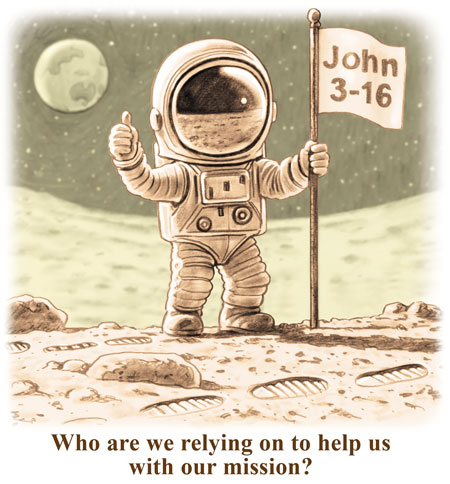 On 20 July 1969, Apollo 11’s astronauts finally achieved what many thought impossible – they landed on the Moon. These astronauts were among the most trained, disciplined, and prepared people on Earth. Yet, even with all their knowledge and skill, their mission’s success – and their very survival – depended on their connection to Mission Control. Every movement and correction relied on the guidance and steady communication from Earth. Without that link, the smallest error could have meant disaster. On 20 July 1969, Apollo 11’s astronauts finally achieved what many thought impossible – they landed on the Moon. These astronauts were among the most trained, disciplined, and prepared people on Earth. Yet, even with all their knowledge and skill, their mission’s success – and their very survival – depended on their connection to Mission Control. Every movement and correction relied on the guidance and steady communication from Earth. Without that link, the smallest error could have meant disaster.
As followers of Christ, we too may be well-prepared and capable, but our spiritual success depends entirely on our connection with God. Prayer keeps us in constant contact with our divine Commander. When we stop listening, we drift off course. Staying tuned to His voice gives us direction, strength, and the wisdom to face the unknown. Like a spacecraft navigating the silence of space, our lives need continual guidance from our Heavenly Mission Control.
Every believer’s mission – whether in a foreign land, a workplace, or a classroom – comes with challenges and crises. In those moments, faith must replace fear. Instead of panicking, we call on the Lord, who sees the full picture and knows the safest path home. The Moon landing proved that what once seemed impossible could be done. With God, our mission may also reach heights beyond imagination.“With God all things are possible.” Matthew 19:26.
The astronaut’s footprints on the Moon remain, untouched and enduring. Likewise, the steps of faith we take can leave a lasting impact for generations to come. We should ask ourselves what kind of spiritual footprints are we leaving behind?
“I can do all things through Christ who strengthens me.” Philippians 4:13.
Back to Top ------------------------------------------------------------------------------------------------ |
Painting a SOUL Portrait
 The easiest portrait for an artist to paint is a self-portrait. The artist intimately knows their own features and all they need is themselves, a mirror and the right light. Plus, when the artist is ready to paint, they are always ready to model. Added to this, they have the luxury of reworking their own image until it is exactly the way they want. The easiest portrait for an artist to paint is a self-portrait. The artist intimately knows their own features and all they need is themselves, a mirror and the right light. Plus, when the artist is ready to paint, they are always ready to model. Added to this, they have the luxury of reworking their own image until it is exactly the way they want.
On the other hand, there are numerous problems painting someone else’s portrait. The subject may not be available when the artist is ready to paint. The subject may be a fidgety model. Then, on completion, the subject is rarely satisfied with the finished result.
As Christians, we should be constantly working on our own “soul-portrait”. We do this by looking into the Mirror-of-the-Word, illuminating ourselves in the Light-of-Truth, and painting with Brushes-of-Faith. The more we practice the better our technique, and our soul-portrait will be composed of graceful inner beauty and coloured with Christ-like attributes.
However, as we work on our own portrait there is always the temptation to dabble in other people’s paintings. When we hear an inspiring message we think someone we know needs to be hearing this. Or, when we read a compelling article we apply it to someone else – instead of ourselves. It’s not a bad thing to want loved ones to hear messages that have personally impacted us, but the problem comes when we get frustrated when they show lack of interest. The fact is they may not be ready for that information at their present stage of growth.
We should stop dabbling in other people’s portraits and concentrate on our own Christian image. As long as we are alive we are a work in progress. If we use the right techniques, eventually our soul-portrait will have a striking resemblance to that of Christ and when we exhibit ourselves to the world people will start asking (without coercion) what joyful colours and inspirational methods we used, so they can apply them to their own soul-portraits.
All Scripture is given by inspiration of God, and is profitable for doctrine, for reproof, for correction, for instruction in righteousness, that the man of God may be complete, thoroughly equipped for every good work. 2 Timothy 3:16-17.
Back to Top ------------------------------------------------------------------------------------------------ |
Where We Focus
 Two birdos (bird-watchers) sat restfully on a hill with binoculars raised. One birdo was looking skywards and the other was focused on the valley below. Suddenly, the birdo looking into the valley jumped in rage. ‘Did you see that blasted cat? No doubt on its way to eat some beautiful bird! Doesn’t it make your blood boil?’ Two birdos (bird-watchers) sat restfully on a hill with binoculars raised. One birdo was looking skywards and the other was focused on the valley below. Suddenly, the birdo looking into the valley jumped in rage. ‘Did you see that blasted cat? No doubt on its way to eat some beautiful bird! Doesn’t it make your blood boil?’
The other birdo shrugged her shoulders. ‘Sorry, didn’t see it. I’ve been focusing on that magnificent eagle flying peacefully above us.’
Are we stressed or are we relaxed? The answer to that is usually determined by the focus of our thoughts. Stress and worry can be easily justified - often this world is a horrible place teeming with many injustices. However, if we allow our thoughts to focus on these worldly things, we will eventually develop a depressed and pessimistic outlook on life. This outlook will soon infect everything we do.
Frustration and stress is often a sign that we are overwhelmed by our goliath problems and not trusting in God. If we focus our thoughts heavenward, confident in the knowledge that God can take care of all the injustices of life and our overwhelming problems, the result will be inner peace.
On another note, we all mess up at times and God handles our falls through grace. When we focus on God’s grace and how every day we receive that which we don’t deserve (divine mercy instead of judgment), in turn we will be graceful, forgiving and mentally relaxed towards others.
‘But those who wait on the Lord shall renew their strength; they shall mount up with wings like eagles, they shall run and not be weary, they shall walk and not faint.’ Isaiah 40:31
Back to Top ------------------------------------------------------------------------------------------------ |
Lessons Learnt
 In eternity-past, angels were created in heavenly paradise. From their beginning they enjoyed God’s unrestrained love and blessings. They knew nothing of suffering, sickness, aging or corruption – these were abstract concepts to them which they had no personal experience. It is only through the consequences of the Fall and human history that angels are learning (and experiencing) God’s attributes of judgement and grace. In eternity-past, angels were created in heavenly paradise. From their beginning they enjoyed God’s unrestrained love and blessings. They knew nothing of suffering, sickness, aging or corruption – these were abstract concepts to them which they had no personal experience. It is only through the consequences of the Fall and human history that angels are learning (and experiencing) God’s attributes of judgement and grace.
Conversely, humans are born into a corrupt world filled with suffering, violence, deprivation and pain. However, as Christians, we are told that when we die all these horrible things will pass away (Rev 21:4). We will then be the recipients of God’s unrestrained love and blessings (as were the angels). We will never again feel pain, suffer or get sick. In our present condition, it is beyond our comprehension to grasp how wonderful eternity will be.
Human history is lesson-time for both angels and humans. God never wanted to teach about judgement, suffering and death; He created both angels and humans in perfect environment. However, when a being is created with absolute free-will, eventually rebellion is bound to happen. God, being perfect, must deal with the repercussions of sin. In so doing He demonstrates to all His creatures that a perfectly loving God still has to condemn sin if He is to remain perfectly fair, just and righteous. God has to judge and condemn all fallen creatures; however, God has another attribute to teach us about: GRACE.
As angels watch human history they witness God’s justice and grace in action (1 Peter 1:12). We humans are the recipients of God’s grace in our self-induced classroom of suffering. Romans 6:23 states: For the wages of sin is death, but the gift of God is eternal life in Christ Jesus our Lord. For any person who believes in Christ, human history and suffering are thankfully a short lesson.
As angels continue to watch us humans to learn more about God’s justice and grace, we too must ask ourselves if we are learning our lessons. Most importantly, accepting God’s gift of salvation by believing in Jesus Christ – He who believes in the Son has everlasting life; and he who does not believe the Son shall not see life, but the wrath of God abides on him, John 3:36.
God wants all to come to Christ and eternal life. In heaven, God has so many wonderful lessons to teach us – an eternity of His unrestrained love and blessings. And God will wipe away every tear from their eyes; there shall be no more death, nor sorrow, nor crying. There shall be no more pain, for the former things have passed away. (Rev 21:4).
Back to Top ------------------------------------------------------------------------------------------------ |
On the Knife's Edge
 Do we ban all knives because they can be misused? For the majority of us, knives are very beneficial and we use them daily. Without them, working in the kitchen or eating at the dinner table would be a very difficult task. Do we ban all knives because they can be misused? For the majority of us, knives are very beneficial and we use them daily. Without them, working in the kitchen or eating at the dinner table would be a very difficult task.
Many things in life have the potential of being misused and abused – including money, sex, drugs, television, electronic games, cars, social life, music, books and fashion. The list is long but, just as with knives, all are susceptible to misuse and abuse. As Christians, we are often guilty of completely banning legitimate things because they have the potential to cause harm. Yet blanket-banning these things solve little; in fact, it can cause greater problems later on.
God wants us to benefit from life’s-knives without hurting ourselves or others. The apostle Paul advised Timothy to take some wine for his stomach’s sake (1 Tim. 5:23), but the Bible also mandates us to abstain from drunkenness. Drugs are good for medicinal purposes; money is good for providing; games for recreation, sex for marriage, work for production; exercise and eating for health. However we harm ourselves and those around us when get addicted to drugs, gaming or pornography; when we become obsessed with money, work and exercise; or when we overeat to the jeopardy of our future health.
God does not want us to ban legitimate things that have the potential to be misused or abused, nor does He want us to closet ourselves and our loved ones away (like monks in a monastery) so we’ll not be tempted. As children are taught to safely handle knives before they can use them, God wants us to gain capacity and mastery so we enjoy the benefits and avoid the harm.
As a parent, we should consider what we are banning from our children. If possible, we should teach them how to responsibly handle life’s-knives so as not to injure. Otherwise, should everything with potential for misused be banned, we shouldn’t be surprised when later they mishandle these things and hurt themselves. Education is the key – God has given us biblical instruction on misuse and abuse to help us determine the safe side of ‘life’s-knives’.
I know how to be abased, and I know how to abound. Everywhere and in all things I have learned to be full and to be hungry, both to abound and suffer need. I can do all things through Christ who strengthens me. Philippians 4:12-13
Back to Top ------------------------------------------------------------------------------------------------ |
Spiritual See-saw
 A see-saw is a plank balanced in the centre of an upright support in such a way that each end can rise and fall alternately. To function properly, a see-saw needs an equal load on both ends. A single person sitting on a see-saw is just a dead weight and a sad sight to behold. A see-saw is a plank balanced in the centre of an upright support in such a way that each end can rise and fall alternately. To function properly, a see-saw needs an equal load on both ends. A single person sitting on a see-saw is just a dead weight and a sad sight to behold.
Our spiritual life is like a see-saw. God is the upright support in the middle which never moves. The plank is our spiritual life. On one side we must balance – ‘studying the Word’. On the other side – ‘spiritual production’. One without the other results in either a dead-spiritual-life or the production of dead-works.
Study of God’s Word without production is like a tree that never bears fruit. Works without study inevitably result in the production of wood, hay and stubble to be burnt at the ‘Judgement Seat of Christ’ (1 Cor 3:12-15).
As with most things there must be a balance; however, one does come before the other: learning the Word always comes before production. God’s Word is our compass, it motivates and inspires us to think and act in the Spirit. If we neglect our time in the Word, our eyes will turn from God and we will be occupied with the things of the world. No matter what great things we are accomplishing, our motives will soon be self-focused instead of God-focused.
Alternatively, if there is only study and no production there will be no movement in our spiritual lives. We become a spiritual-dead-weight moving nowhere. The fruit of the Spirit is right thinking turned into right actions. Our spiritual life is something that should always be in motion. When we start applying and putting into practice the Biblical truths we have learnt, we will start gaining momentum in our spiritual life. The wisdom we have gained will transform our thoughts, speech, motives and actions. Soon, we will be amazed at how God opens doors and utilizes us because we are consistently occupied with Him and doing right things in a right way.
“Therefore whoever hears these sayings of Mine, and does them, I will liken him to a wise man who built his house on the rock.” Matthew 7:24
Back to Top ------------------------------------------------------------------------------------------------ |
Raising Our Glass
 In many cultures, when someone accomplishes something remarkable, we raise our glasses in their honour. A toast is a symbolic gesture – an outward expression of inward respect. But not all toasts carry the same weight. A heartfelt toast from a wise, thoughtful person holds far more meaning than the slurred praise of an emotional drunk. In many cultures, when someone accomplishes something remarkable, we raise our glasses in their honour. A toast is a symbolic gesture – an outward expression of inward respect. But not all toasts carry the same weight. A heartfelt toast from a wise, thoughtful person holds far more meaning than the slurred praise of an emotional drunk.
In the same way, our praise to God should be thoughtful, intentional, and filled with understanding. God is perfect in every way – His works are magnificent, His character flawless, and His grace beyond measure. He is more than deserving of constant praise. But before we lift our souls to heaven in worship, prayer, or communion, we are called to pause and examine our hearts. Are we spiritually sober? Are we in right fellowship with Him? Scripture reminds us to confess our sins and walk in the light so that our worship is not just noise, but a genuine offering (1 John 1:9).
We must also ask: are our souls full of truth? Empty, emotional words, even when spoken in reverence, are still empty. But when we fill our minds with the Word of God – when we reflect on who He is and what He has done – our praise becomes rich, meaningful, and pleasing to Him. A soul steeped in Scripture raises a much more powerful “toast” to heaven than one running on ritual or an emotional high.
So let us not offer God hollow praise. Let us be spiritually awake, filled with His Word, and deeply aware of the One we are honouring. Only then can we raise our hearts to Him in a way that brings true glory to His name.
“Let the word of Christ dwell in you richly… singing with grace in your hearts to the Lord.” Colossians 3:16 .
Back to Top ----------------------------------------- |
The Critical Eye
 A man was busy fishing when his wife showed him a glassy, fist-sized, muddy rock. He gave it a critical look and said, ‘Toss it away. I don’t want dirty things messing up my car’. A man was busy fishing when his wife showed him a glassy, fist-sized, muddy rock. He gave it a critical look and said, ‘Toss it away. I don’t want dirty things messing up my car’.
The lady wiped the rock and again held it out to her husband, saying, ‘Take a closer look, Dear. This is what is traditionally known as a diamond-in-the-rough.’
As sinners living in a corrupt world, we are all filthy with sin. A critical eye will only see the bad in everything: people, circumstances, literature, fashion, media and so on.
As Christians, God has given us a righteous standard of living and we should stay vigilant to unsavoury influences – no one wants dirt to mess up their clean living. However, an occupational hazard of Christianity is turning into a self-righteous Pharisees who see nothing of worth in the tax collectors, prostitutes and coarse things of this world.
A critical eye only sees the faults and failings, not treasures hidden within. We must come to see people and circumstances as God sees them – ugly ducklings needing growth to become white swans.
That’s not to say every dirty rock is a diamond-in-the-rough. However, if we hope to discover treasures in life, expect them to be covered with some dirt and needing a bit of polish.
Be tolerant with one another and forgiving, if any of you has cause for complaint: you must forgive as the Lord forgave you. Colossians 3:13 REB
Back to Top ------------------------------------------------------------------------------------------------ |
Whip of Judgement
 Anyone familiar with using a whip knows it should be handled with great care. If used incorrectly, a whip can flick back at the same speed as when lashed out. Many beginners have caused nasty injures to themselves by not knowing the right technique. Anyone familiar with using a whip knows it should be handled with great care. If used incorrectly, a whip can flick back at the same speed as when lashed out. Many beginners have caused nasty injures to themselves by not knowing the right technique.
God has given each of us a ‘Whip of Judgement’. It was never designed to be used on others. Its purpose is to help in self-restraint. With correct use, our judgement-whip will not injure but encourage our own personal advancement. Objectively judging ourselves is a very good practice; it keeps us moving forward on the right track.
However, we are strictly forbidden to misuse our whip to judge and criticize others. Indeed, God has made sure that should our ‘Whip of Judgement’ be used on others, it will snap back to injure us at the same speed as we lashed it out. As stated in Matthew 7:1-2: Judge not, that you be not judged. For with what judgement you judge, you will be judged; and with the measure you use, it will be measured back to you.
If God does give us insight into the lives of those around us, it is not so we can judge them, but to intercede with prayer on their behalf. If they need correction, God will do it with tender mercy.
Therefore you are inexcusable O man, whoever you are who judge, for whatever you judge another you condemn yourself; for you who judge practice the same things. Romans 2:1.
Back to Top ------------------------------------------------------------------------------------------------ |
Cluttered
 Keeping a home clean is a continual effort. No matter how neat it looks on the outside, if we’re just sweeping the dust under the rug or stuffing clutter into closets, it won’t be long before it is a mess again. Surface cleaning might provide a temporary fix, but true cleanliness requires a deep and intentional clearing out. Every now and then, we need a good spring-clean – because a cluttered home can never be an organised one. Keeping a home clean is a continual effort. No matter how neat it looks on the outside, if we’re just sweeping the dust under the rug or stuffing clutter into closets, it won’t be long before it is a mess again. Surface cleaning might provide a temporary fix, but true cleanliness requires a deep and intentional clearing out. Every now and then, we need a good spring-clean – because a cluttered home can never be an organised one.
The same is true for our soul; however our soul is not a temporary dwelling – it is our eternal home. Just like our physical homes, it gathers clutter daily: the dust of sin, the residue of worry, the build-up of hurt, fear, jealousy, and bitterness. We might smile and appear composed on the outside, but inwardly we may be an inner mess, carrying burdens that weigh us down.
Hiding our brokenness doesn’t heal it. Ignoring our pain doesn’t bring peace. Pushing things into the back rooms of our heart only invites chaos to multiply. A cluttered soul is a weary soul. But the good news is this: we don’t have to live that way. God invites us to bring our mess to Him – not just occasionally, but continually (1 John 1:9). He isn’t overwhelmed by our clutter. He lovingly enters into it and helps us sort through every piece. In His presence, we find the clarity, healing, and freedom our hearts long for.
Just as we feel refreshed in a clean, peaceful home, so too will we experience rest and renewal in a soul made whole by the gentle hand of the Father. That kind of inner peace doesn’t just change how we feel – it changes how we live.
"Create in me a clean heart, O God, and renew a steadfast spirit within me." Psalm 51:10
Back to Top ------------------------------------------------------------------------------------------------ |
Artists & Vandals
 Both artists and vandals leave their mark. So what are some of the differences that separate them? Artists create while vandals destroy. Artists leave their mark in appropriate places while vandals don’t care where they leave their mark. Artists try to inspire, while vandals demoralise. Artists endeavour to add to beauty, while vandals take from beauty. Both artists and vandals leave their mark. So what are some of the differences that separate them? Artists create while vandals destroy. Artists leave their mark in appropriate places while vandals don’t care where they leave their mark. Artists try to inspire, while vandals demoralise. Artists endeavour to add to beauty, while vandals take from beauty.
We should ask ourselves if what we have created is worthy of exhibition in our own lives and in the lives of others. For instance, do we always expect encouragement from others yet never give it; demand help yet never offer it; insist on honesty but deal in dishonesty; always take but never give; pursue ambition not caring who is knocked down? If on reflection we answer in the affirmative, then we are not artists, we are vandals.
If our life is a trail of devastation and broken relationships, we have certainly left our mark (much to the detriment of everyone who has known us). Our selfish actions are a direct result of our selfish thinking. If we want to change, we need to renovate our thinking.
God wants us all to be life-artists. We are to encourage, aid and inspire – to build people up and help them look heavenward. If we are sensitive to needs of others and give them a hand with their burdens, people’s lives will be better because we are in them. God desires that we create many ‘spiritual artworks’ in the lives of others that He will exhibit forever in eternity.
Let your light so shine before men, that they may see your good works, and glorify your Father which is in heaven. (Matthew 5:16)
Back to Top ------------------------------------------------------------------------------------------------ |
Driving in Our Spiritual Car
 Cars are a means of transport – they are wheeled vehicles propelled by the use of a motor. Cars are a means of transport – they are wheeled vehicles propelled by the use of a motor.
Our spiritual life is like a car and, when we first believe in Jesus Christ, we receive one as a birthday present. God supplies unlimited power to our car’s super-engine. If we wish to go places in our car (spiritual life) we must first get in (1 John 1:9), turn on the ignition (faith) and place our foot on the pedals (personal motivation and drive). The steering wheel is our volition and it is up to us in which direction we head. However, God does not leave us to drive around aimlessly – there’s a map in the glove box to direct us (Bible), but we must read it to be of any use. We also have a radio (a still, small voice); if we listen, we’ll get regular traffic reports and know which roads to avoid.
God has designed a uniquely individual spiritual life for each of us. It saddens Him when we leave our spiritual-car in the shed and choose to walk (doing everything by our own energy) or worse, go hitching for a lift (relying on the power of others).
Back to Top ------------------------------------------------------------------------------------------------ |
Pulling the Trailer
 A trailer has no engine. It was never designed to be a self-powered vehicle. Trailers are designed to carry loads and can only move if attached to a source of power. If our trailer has a heavy load and a long way to travel, we attach it to a car, knowing it won’t get very far if we try to pull it ourselves. A trailer has no engine. It was never designed to be a self-powered vehicle. Trailers are designed to carry loads and can only move if attached to a source of power. If our trailer has a heavy load and a long way to travel, we attach it to a car, knowing it won’t get very far if we try to pull it ourselves.
Our trailer (Christian works) is attached to our car (spiritual life). The one should naturally follow the other (if we are thinking right things we will naturally do right things). When God is the power in our spiritual life, our work should never exhaust us - our burden should be light. The first priority should always be our relationship with God - He is the source of power. If we are becoming tired, maybe it is because we left our car (spiritual life), unhooked the trailer (Christian works) and tried to pull it ourselves. The sad truth is, if we are pulling our trailer (just doing works), we are going nowhere in our car (spiritual life). Soon, we’ll become exhausted and hinder everyone on the road. Eventually, other people will need to take our load because we are too fatigued to carry on.
Back to Top ------------------------------------------------------------------------------------------------ |
Weapons of Mass Destruction
 A boy was having the time of his life shooting arrows aimlessly into the air without thinking where they landed. Suddenly, his father rushed out, swiftly taking the bow from his hands. Startled and upset, the boy protested, ‘Dad, I was just having fun! Why did you stop me?’ A boy was having the time of his life shooting arrows aimlessly into the air without thinking where they landed. Suddenly, his father rushed out, swiftly taking the bow from his hands. Startled and upset, the boy protested, ‘Dad, I was just having fun! Why did you stop me?’
With a calm but firm voice, the father replied, ‘Son, you were so caught up in your fun, you didn’t realize the harm you’re causing.’
How true this is for us today. In our everyday conversations – especially in casual gatherings or on social media – it has become all too easy, and even entertaining, to "shoot arrows" with our words. Our gossip, criticism and judgment may seem harmless in the moment, but like an arrow released from a bow, once spoken, our words cannot be taken back.
We must never forget that words have weight. Careless talk can pierce hearts, ruin reputations, and cause deep emotional wounds. We may not always see the damage immediately, but God does. And He cares deeply about how we use the gift of speech.
The Lord calls us to a higher standard. Our mouths were created not to wound, but to bless – to build up, not to tear down. Every word is an opportunity to reflect the love and truth of Christ. Instead of firing off unguarded remarks, let us ask the Holy Spirit to guide our tongues that we may speak with encouragement, patience, and grace.
As Scripture reminds us: Let the words of my mouth and the meditation of my heart be acceptable in Your sight, O Lord, my strength and my redeemer. Psalm 19:14.
Back to Top ------------------------------------------------------------------------------------------------ |
Making Impressions
 Prints are made using a variety of methods, yet the basic process is the same: an image is engraved onto a plate – whether metal, wood or stone – then inked and pressed onto another surface. The result is a reflected impression of the original engraving. Prints are made using a variety of methods, yet the basic process is the same: an image is engraved onto a plate – whether metal, wood or stone – then inked and pressed onto another surface. The result is a reflected impression of the original engraving.
In much the same way, our lives are a reflection of what is engraved in our soul. We begin life with a blank plate – an untouched soul – ready to receive impressions. Over time, others leave their marks, shaping who we become. This is why we must be discerning about who and what we allow to impress us. A wrong impression can distort and damage a soul.
Just as importantly, we must be mindful of the impressions we leave on others – especially on children, whose souls are soft and easily marked – they take in every word, every action. A careless remark or poor example can leave a lasting imprint. Though we might regret it later, the damage may already be done. Many plates are ruined due to the bad impressions etched upon them.
But there is hope. Christ, the Master Printmaker, speaks and acts with perfect care. When we allow Him to print His image upon our hearts, the result is nothing short of a masterpiece. Each life touched by His hand becomes a living testimony of grace, beauty, and purpose—uniquely crafted, yet bearing the unmistakable image of our Creator.
So let us choose today to allow Christ to leave His mark on us. And let us, in turn, leave impressions that reflect His grace, mercy and truth. Even the most damaged plate can become a masterpiece when touched by His hand.
But we all, with unveiled face, beholding as in a mirror the glory of the Lord, are being transformed into the same image from glory to glory, just as by the Spirit of the Lord. 2 Corinthians 3:18.
Back to Top ------------------------------------------------------------------------------------------------ |
Holiday Snapshots
 A holiday can be a time of personally discovering new things. Most of us take photos to remember these exciting events. Naturally, when arriving home, we want to share our experiences with family and friends. However, we soon discover most people are not as excited about our snapshots as we are. A holiday can be a time of personally discovering new things. Most of us take photos to remember these exciting events. Naturally, when arriving home, we want to share our experiences with family and friends. However, we soon discover most people are not as excited about our snapshots as we are.
Christianity is a personal journey. As Christians seeking truth we will be led by the Holy Spirit to many new discoveries (points of truth suddenly made real). It is natural to be excited about our spiritual-breakthroughs. Passionately, we want to share what we have discovered with those around us. But we should not be disappointed when others don’t show the same enthusiasm for our ‘spiritual snapshots’. People have so much going on in their lives. Unless they have discovered the same Spiritual Truth, we can’t expect them to be excited as we are.
However, people’s indifference to our excitement should not discourage us from viewing life as one grand holiday of spiritual discovery. God the Father is our Travel Agent, Christ has covered the cost and the Holy Spirit is our Tour-guide. When we enjoy all aspects of life (content in prosperity and adversity), others soon take note. They will ask how we can be so relaxed and filled with passion, like one continuous holiday. This is our opportunity to tell them about our Travel Agent, so they, too, can book themselves on the spiritual tour where God will lead them to discover what we have experienced and take snapshots of their own.
Therefore, if anyone is in Christ, he is a new creation; old things have passed away; behold, all things have become new. 2 Corinthians 5:17
Back to Top ------------------------------------------------------------------------------------------------ |
Things Babies Do
 Babies do many things we would be ashamed to do as adults. They suck thumbs, fill nappies, vomit on people and all their bodily functions run riot – it’s just a fact of life. We all did these things as babies, but on reflection there is no embarrassment because we know those are simply the things babies do. Babies do many things we would be ashamed to do as adults. They suck thumbs, fill nappies, vomit on people and all their bodily functions run riot – it’s just a fact of life. We all did these things as babies, but on reflection there is no embarrassment because we know those are simply the things babies do.
At times, Christians quietly ask themselves: In Heaven, will I always be humiliated by the hurtful and shameful things I did on Earth?
One could speculate that in Heaven, with a new resurrection body and separated from our earthly sin-nature, we will be so far advanced from our present state that we will look back over our time on Earth without lasting embarrassment – no matter the stupid things we have done. The gap between our resurrected-self and how we were on Earth will be far greater than that between an adult and baby.
Thankfully, when resurrected, we will remember without mortification our time on Earth when our revolting sin-natures were running riot. Jesus Christ paid for all our sins to rub our slate clean – Heaven is the ultimate fresh start. The promised joy is presently beyond our comprehension, but we can certainly surmise there will be no place for any lasting regrets or shame.
“And God will wipe away every tear from their eyes; there shall be no more death, nor sorrow, nor crying. There shall be no more pain, for the former things have passed away.” Rev 21:4.
Back to Top ----------------------------------------------------------------------------------------------- |
Tearing Down the Old
 Normally, people don’t want to live in an old, leaky, run-down house built on a shaky foundation. If they have the resources, they will tear down that old structure to rebuild a new house on a strong foundation. Normally, people don’t want to live in an old, leaky, run-down house built on a shaky foundation. If they have the resources, they will tear down that old structure to rebuild a new house on a strong foundation.
We all live within the confines of our beliefs. We should ask ourselves: what ‘structure-of-thinking’ have I built which I am now living in? Do I believe that money will buy me happiness? Most people would quickly say, ‘No, it won’t’; however, all their life choices says that it does.
Think about it honestly – are we living in the belief that happiness and fulfilment will be acquired with the attainment of wealth, power, beauty or the approbation of others? Do we believe getting married (or divorced) will solve all our problems? Do we think achieving great accomplishments will fill the emptiness? These are all structures of thinking that the world has sold to us, but they are built on very shaky foundations.
Does any lasting happiness reside in worldly things? The people who acquire them quickly realise the happiness is fleeting and whatever they have is soon not enough. The Bible beautifully illustrates in Ecclesiastes that chasing happiness through worldly things is just vanity and grasping for the wind. Sadly, it’s only when we finally acquire what we thought would bring us true fulfilment do we realise what a flimsy belief we’d been living in.
God wants us to be happy in all circumstance (good and bad) and He has instructed us how to do this. To attain this divinely promised happiness we need to renovate our thinking. We need to tear down our shaky, old ‘happiness-beliefs’ and rebuild on a solid foundation of our Lord Jesus Christ. When we start thinking as our Lord did, we construct on a solid foundation of truth that will confidently see us through all the peaks and valleys of life. Set your mind on things above, not on things on the earth (Col 3:2).
If we want true happiness that lasts into eternity, we need to build our thinking on a Biblical framework that God has ordained for us. Do not be conformed to this world, but be transformed by the renewing of your mind, that you may prove what is that good and acceptable and perfect will of God. Romans 12:2.
Back to Top ------------------------------------------------------------------------------------------------ |
Glow in the Dark
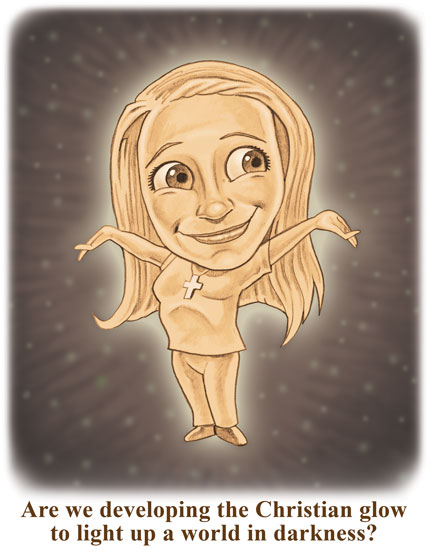 If you expose phosphorus to a bright light and then switch off the lights, it continues to glow in the darkness. This happens because it absorbs energy and gradually releases it as light. If you expose phosphorus to a bright light and then switch off the lights, it continues to glow in the darkness. This happens because it absorbs energy and gradually releases it as light.
As Christians, we are Christ’s representatives in a world filled with dishonesty, despair and selfishness. Jesus calls us to be lights in the darkness. But how is that possible when we still have a sinful nature and are capable of the same selfish behaviour we see in the world around us?
In a sense, we are to be like phosphorus. As we continually expose ourselves to the light of God’s Word, His truth transforms our thinking and reflects Christ’s character through us. When given the opportunity for revenge, we choose forgiveness. When tempted to cheat, we act honestly. When selfishness seems easier, we gladly serve. When life becomes stressful, we learn to trust God instead of giving way to fear. As believers are continually energised by God’s promises and commands, they become gracious lights in a dark world.
But we must never assume our Christian glow will continue on its own. Just as phosphorus must first absorb light before it can shine, we must continually feed on God’s Word. Otherwise, our love for Christ will cool, our focus will drift back to ourselves, and the grace that once shone through us will slowly give way to the attitudes of the world.
On the other hand, when we regularly study Scripture, meditate on its truths and apply them to our daily lives, our focus shifts from ourselves to all that the Lord Jesus Christ has done – and continues to do – for us. Gratitude fills our hearts, grace flows towards others, and Christ’s light shines naturally through our lives. That quiet, consistent glow becomes a beacon of hope, pointing people beyond us to the Saviour who alone can bring them out of darkness.
“Let your light so shine before men, that they may see your good works and glorify your Father in heaven.” Matthew 5:16
Back to Top ------------------------------------------------------------------------------------------------ |
Wishful Thinking
 For years boys have been wishing they were Superman, but what happens when a boy straps on a cape and jumps off a roof hoping to fly like his idol? Well, for a brief moment there is exhilaration – thereafter is the crashing to earth. For years boys have been wishing they were Superman, but what happens when a boy straps on a cape and jumps off a roof hoping to fly like his idol? Well, for a brief moment there is exhilaration – thereafter is the crashing to earth.
What is our wishful thinking? What worldly philosophies are we buying into? Racy TV shows infer if we are promiscuous we’ll have a passionate and adventurous love life. We tune in to watch glamorous characters go through many sex partners without any consequences in following episodes. Yet if we imitate these fictional characters, will we get off scot-free in the real world? No, it is wishful thinking believing we can play the field and have no repercussions for ourselves and all involved.
Or maybe we are impressed with movies that portray the party life of excessive drinking and drug taking as the way to fun and popularity. Do we really think we will get those positive results if we mimic this damaging lifestyle?
Or what if we start imitating the ‘super independent’ lone-wolf character that hits hard and hits first? In reality this self-absorbed thinking is a quick way to lose what friends you still have and lands you in big trouble as that attitude develops into violence.
We must be very careful of our wishful thinking. Movies, computer games and music can have a powerful influence on us and can glamorise certain lifestyles. Yet if we mimic these lifestyles in the real world, like the boy who jumps off the roof hoping to fly, there will be a brief moment of exhilaration before we come crashing to earth.
God implores us to keep away from an unrestrained life of partying, illicit drugs, sex and violence. He does this not to stop our fun, but to stop us ruining our lives with the repercussions. It is our choice. The battle is lost or won in our thinking.
“And do not be conformed to this world, but be transformed by the renewing of your mind…” Romans 12:2a
Back to Top ------------------------------------------------------------------------------------------------ |
A Christmas Illustration
 Over the years Christmas has lost its Christian focus. Even so, from among the Santas, elves, Christmas trees, stockings and presents emerge some wonderful illustrations of the true meaning of Christmas. Over the years Christmas has lost its Christian focus. Even so, from among the Santas, elves, Christmas trees, stockings and presents emerge some wonderful illustrations of the true meaning of Christmas.
1.) Santa is a joyful giver ruling benevolently from the North Pole / God is a gracious giver ruling benevolently from Heaven.
2.) Santa reads all the mail sent to him by children of the world, then tailor-makes gifts for each child / God listens to every prayer sent to Him by His earthly children, then tailor-makes blessings for the individual needs of each.
3.) Santa has elfin helpers working towards his goals / God has elect angels working tirelessly for His glory.
4.) The Christmas tree is where wonderful gifts can be found / The Tree of Christ (the Cross) is where the incomparable gift of eternal salvation can be found.
5.) Children who are nice or naughty will have their Christmas stocking filled either with presents or with coal / Likewise, whether we follow God’s plan or our own determines if our lives will be filled with blessing or with self-inflicted-problems.
Every day should be Christmas for the Christian. We have been given the ultimate Christmas gift – Eternal Salvation. It is the incomparable gift from God that just needs to be accepted, not something we can earn (Eph. 2:8-9).
As Christians, we become the new ‘Christmas-message-ambassadors’. Our job is to herald the Good News of Salvation as the angels did for the shepherds on the very first Christmas: “…I bring you good tidings of great joy which will be to all people. For there is born to you this day in the city of David a Savior, who is Christ the Lord.” Luke 2:10-11.
We have the wonderful opportunity to remind people of the first Christmas where God presented Himself as a gift – a living Sacrifice – and became humanity (the babe in the manger) to wipe away the ‘penalty of sin’ and reconcile the world to Himself so all who believe in Jesus Christ may receive the ultimate Christmas gift of everlasting life.
“For God so loved the world that He gave His only begotten Son (Jesus Christ), that whoever believes in Him should not perish but have everlasting life.” John 3:16
Back to Top ------------------------------------------------------------------------------------------------ |
The Joy of the Easter Hunt
 One of the most loved Easter traditions is the classic Easter Egg Hunt. The imagined Easter Bunny brings a sense of excitement, hopping through gardens, leaving chocolate eggs tucked under bushes, in flowerpots, and behind garden gnomes. Children race about on Easter morning, squealing with delight as they uncover each hidden treasure. The thrill isn’t just in the chocolate – it’s in the search, the surprise, and the joy of discovering something lovingly placed for them. One of the most loved Easter traditions is the classic Easter Egg Hunt. The imagined Easter Bunny brings a sense of excitement, hopping through gardens, leaving chocolate eggs tucked under bushes, in flowerpots, and behind garden gnomes. Children race about on Easter morning, squealing with delight as they uncover each hidden treasure. The thrill isn’t just in the chocolate – it’s in the search, the surprise, and the joy of discovering something lovingly placed for them.
This eager searching beautifully reflects the Christian meaning of Easter. In the same way children delight in finding what the Easter Bunny has hidden, we’re invited to seek the risen Jesus with anticipation and trust. Each colourful egg is like a reminder that God intentionally places signs of His love throughout our lives: moments of grace when we least expect it, comfort during seasons of sorrow, guidance that appears just when we’re unsure, and renewal that breaks through after long struggles. Just as kids sometimes walk straight past an egg without noticing, we too can miss God’s quiet blessings until we pause and look again. And just as some eggs are hidden in tricky spots – under a rock, up a tree branch, or inside a pair of gumboots – God often tucks His lessons in the places that stretch our faith and draw us closer to Him.
The Easter Bunny’s quiet, unseen kindness mirrors the unseen yet faithful work of God, who prepares blessings for us long before we notice them. And the excitement of finally spotting a hidden egg reflects the awe the disciples felt at the empty tomb – the moment they realised Christ had risen and that hope had truly conquered death.
As you enjoy the simple joy of the egg hunt, let it point your heart back to the greatest discovery ever made: that Jesus is alive, and because of His resurrection, new life is available to all who look to Him.
“You will seek Me and find Me, when you search for Me with all your heart.” Jeremiah 29:13
Back to Top ------------------------------------------------------------------------------------------------ |
------------------------------------------------------------------------------------------------------------- |
 Hi there. If you found the above Christian Illustrations useful, please email us and let us know. It certainly encourages us to create more FREE Illustrations in the future. Hi there. If you found the above Christian Illustrations useful, please email us and let us know. It certainly encourages us to create more FREE Illustrations in the future.
Click here to email us at: ianandsue@freechristianillustrations.com |
------------------------------------------------------------------------------------------------------------- |
These Christian illustrations can be used in sermons, religious education or personal use without charge or obligation.
They may be freely downloaded, copied and distributed without permission as long as no cost is charged and source is recognized.
|
 |


